Introducing StatSocial Focus Groups: The AI Focus Group Platform Built on Real Audience Data

StatSocial Focus Groups lets brands, agencies, and communications teams run moderated qualitative research with real, weighted audiences. No recruiting. No weeks of fielding. Every respondent is drawn from observed behavioral social data on 150+ million U.S. adults, grounded in StatSocial’s patented PeopleGraph, and calibrated against U.S. Census and Pew Research Center benchmarks, so teams know exactly how representative each voice is.
Unlike other AI focus group platforms that generate personas and answers from a prompt, StatSocial uses AI to surface responses based on the observed behavior of real people.
In this post:
- Rethinking the traditional focus group
- What is an AI focus group platform?
- The limitation of traditional focus groups
- How StatSocial Focus Groups work: real, weighted audiences
- How StatSocial Focus Groups differ from synthetic & AI focus group software
- From survey responses to conversation in one workflow
- How accurate are AI focus groups?
Rethinking the traditional focus group
Marketers have never had more ways to understand their audiences. They can survey customers, analyze campaign performance, monitor social conversations, study creator communities, and increasingly use AI to pressure-test ideas before they go to market.
Yet when they need to understand how people actually think, react, or explain a decision in their own words, the process hasn’t changed much. Traditional focus groups still require weeks of recruiting, scheduling, and moderation. AI-generated personas have made qualitative research faster, but they ask marketers to trust conversations built from inferred profiles rather than the people they’re trying to understand.
That’s the next problem we’ve set out to solve.
Today, we’re expanding our offerings with Focus Groups, extending the same behavioral foundation behind Digital Twins, which already enables marketers to survey virtually any audience in hours. Built on StatSocial’s patented PeopleGraph and KnowledgeGraph, Focus Groups gives teams a way to hold moderated qualitative discussions with real, weighted audiences, without recruiting participants or waiting weeks to field a study.
What is an AI focus group platform?
An AI focus group platform is software that uses artificial intelligence to conduct moderated qualitative research conversations. It poses questions, probes follow-ups, and analyzes responses without the recruiting, scheduling, and fielding timelines of traditional qualitative research.
Most AI focus group software falls into one of three camps: tools that use AI to moderate sessions with recruited human participants, tools that layer AI transcription and analysis onto live sessions, and synthetic tools that simulate participants entirely from AI-generated personas.
StatSocial Focus Groups takes an alternative approach. It starts from an audience that already exists, an identity graph of observed behavior spanning 150+ million U.S. adults, and uses AI to surface responses from it. We call this grounded research. It offers the speed of synthetic tools with the representativeness that persona-based AI focus group platforms can’t verify.
The limitation of traditional focus groups
The value of a focus group has always been its ability to explain what the numbers can’t. Surveys can tell you a campaign missed the mark. A conversation reveals why. You hear the hesitation before a purchase, the language customers naturally use, the objections they struggle to articulate in a survey, and the moments where opinions begin to diverge. Those are the insights that shape creative, messaging, and product decisions.
But traditional focus groups have a limitation. It’s the room itself.
Every participant gets an equal seat at the table, but not every opinion carries equal weight in the market.
One participant may reflect a broad segment of your customers. Another may represent a niche perspective. The most vocal voice in the room might speak for only a small percentage of your buyers and still overshadow the majority. Traditional focus groups deliver rich conversation, but they offer little visibility into how representative each voice is.
How StatSocial’s Focus Groups work: real, weighted audiences
StatSocial Focus Groups approach that limitation differently. Every study begins before anyone enters the room.
Respondents are drawn from the same PeopleGraph that powers Digital Twins, a patented identity graph representing 150+ million U.S. adults and enriched with hundreds of observed behavioral signals. That audience is screened to match the study criteria and calibrated against 40+ benchmark studies from sources including the U.S. Census, Pew Research, Gallup, and Nielsen. Every respondent is anonymized before any responses are generated.
The result is a conversation grounded in an existing audience, informed by real behavior rather than a room assembled through recruiting or personas generated from a prompt.
Every respondent speaks for a known number of people within the panel, making it possible to separate mainstream opinion from the fringe instead of treating every quote as equally representative. When someone offers an unexpected perspective, teams can immediately see whether it reflects hundreds of buyers or only a small portion of the audience.
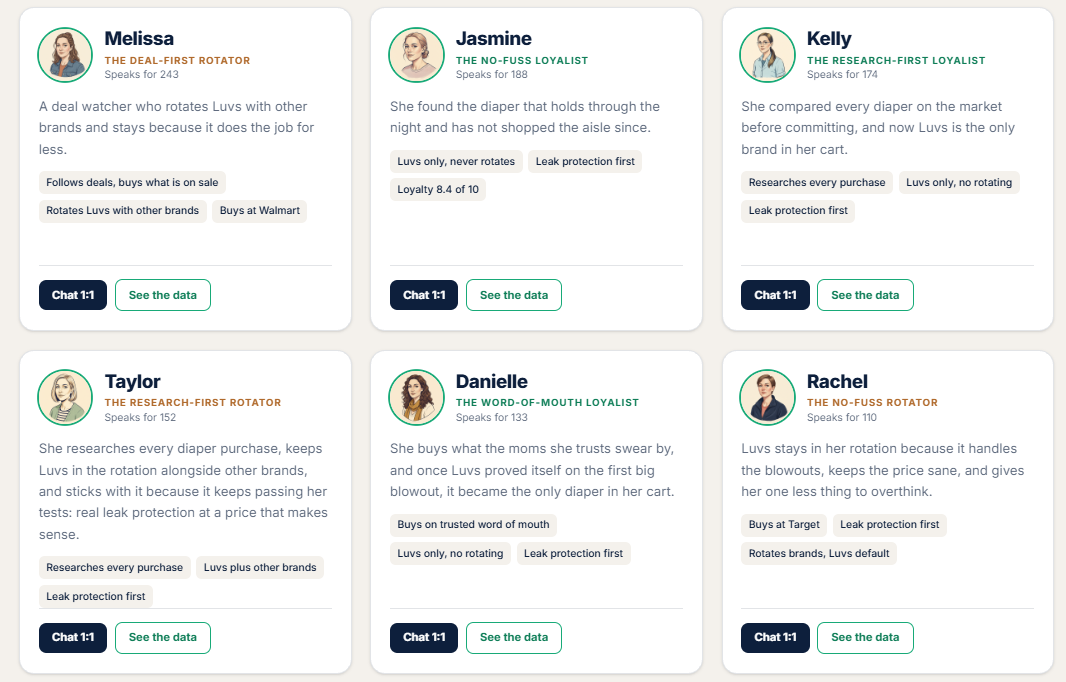
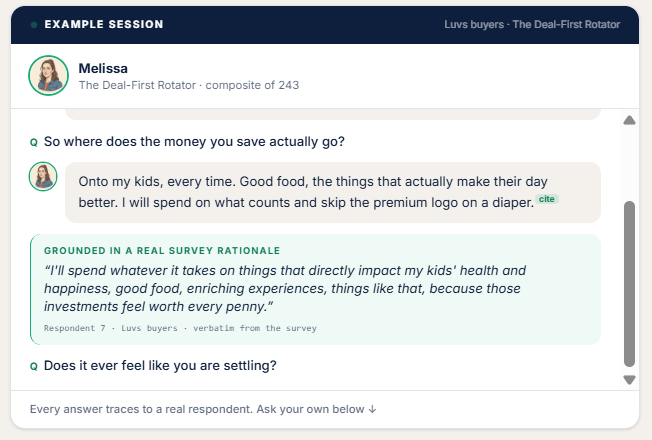
Clicking on any response reveals the underlying cohort, response distribution, and rationale behind it, so teams can show exactly where a quote came from and how representative it is within the audience.
As David Barker, CEO of StatSocial, said in the launch announcement: “When every respondent traces to real people, and every quote carries a weight, teams stop defending the methodology and start acting on the insight.”
How StatSocial Focus Groups differ from synthetic & AI focus group software
Most synthetic focus group software starts with a prompt: describe your target audience, and the tool generates personas to match. The conversation that follows can be fast and inexpensive, but there’s no way to verify that the personas reflect how real buyers actually think. The audience is an assumption, not an observation.
StatSocial Focus Groups inverts that model. The audience exists first, built from observed behavioral data, and AI is used to surface responses from that audience rather than invent them. That difference shows up in three ways:
- Grounded respondents, not generated ones. Every participant is drawn from StatSocial’s PeopleGraph behavioral data rather than invented to fit a brief.
- Weighted representation. Each respondent speaks for a known share of the audience, so a compelling quote can be immediately sized against the market it represents.
- Full transparency. Every response is traceable to its underlying cohort, distribution, and rationale. It’s an audit trail that synthetic AI focus group software can’t provide.
From survey responses to conversation in one workflow
For teams already using Digital Twins, Focus Groups extends a workflow they already know. Digital Twins answers structured questions at scale, helping marketers understand what an audience thinks and how those findings compare with a broader population. Focus Groups begins where that work naturally leaves off. The same audience can now react to new ideas, challenge assumptions, explain unexpected findings, or talk through the reasoning behind a survey result.
Quantitative and qualitative research no longer have to be commissioned separately or reconciled after the fact, because both are built from the same audience on the same foundation.
A brand or agency team can moderate the room, pose questions to every participant, and compare how different respondents, grounded in real behavior, respond. If one answer stands out, that respondent can be pulled into a one-on-one conversation for deeper exploration before returning to the broader discussion. Every response stays connected to the underlying data, and every study exports as both a presentation-ready report and a detailed crosstab for additional analysis.
How accurate are AI focus groups?
AI focus groups are as accurate as the data behind them. Platforms built on AI-generated personas can only be as reliable as the assumptions in the prompt that created them, which is why representativeness remains the most common objection to AI-driven qualitative research.
StatSocial Focus Groups addresses accuracy at the foundation. Respondents are drawn from observed behavior across 150+ million U.S. adults, screened against study criteria, and calibrated against gold-standard benchmarks before a single response is generated.
Across those benchmarks, the underlying model has averaged 3.3 points MAE against real-world survey results, compared to 5 to 6 points for typical opt-in online panels.
The AI is not inventing opinions. It is surfacing them from the observed behavior of real people. Because every answer is weighted and traceable to its underlying cohort, research teams don’t have to take accuracy on faith. They can inspect it.
Move from survey results to real conversations in one platform
The introduction of AI has changed how marketers approach research, yet qualitative methods have remained largely constrained by the same tradeoffs. Focus Groups bring qualitative research onto the same behavioral foundation as Digital Twins, giving marketers a faster path from survey response to conversation without sacrificing confidence in who they’re hearing from. Marketers can move from measuring an audience to talking with it in a single workflow, giving research, insights, and marketing teams a more complete picture before decisions are made.
Learn more about StatSocial’s Focus Group platform and see how brands are using real, weighted audiences to move from survey results to deeper conversations.
Ready to get started? Schedule an intro call with a member of our team.