Influencer measurement tools are instrumental in helping marketers prove if their creator campaigns drove desired outcomes, from engagement to sales lift. In this guide, we compare the six influencer measurement solutions teams turn to most heading into 2027: StatSocial, CreatorIQ, Traackr, Captiv8, Later, and Sprout Social Influencer Marketing. We cover how each measures results, what sets each apart, the limitations to keep in mind, and what to consider before you choose a solution, so you can find the best fit for your influencer program and goals.
Jump to a section
- The main types of influencer measurement
- The 6 platforms, reviewed
- A comparison on how each tool measures results
- How to choose an influencer measurement tool
- Frequently asked questions
The main types of influencer measurement
Influencer measurement shows whether a creator campaign changed perception or behavior, including sales, brand awareness, etc. It’s how teams decide which creators to keep investing in, where to shift budget, and how to prove return to leadership.
Measurement is also key to holding on to, or increasing, influencer spend. In 2025 CreatorIQ reported that, for the first time in 5 years, that lack of measurement surpassed budget as the top barrier to growth in influencer marketing.
Most influencer tools report some KPI, but each type of measurement proves something different. Here’s how the main types compare, including what each one tells you, where it falls short, and which tools offer it.
| Type of measurement | What it tells you | Data it uses | What it can't show | Platforms that offer it |
|---|---|---|---|---|
| Reach and engagement | How many people saw and interacted with an influencer’s posts | Impressions, views, likes, comments, and shares | Whether anyone bought, or if perception changed | Sprout Social Influencer Marketing, Captiv8, CreatorIQ |
| Earned media value (EMV) | What the attention would have cost as paid media | Reach and engagement, priced with a formula | Actual sales or brand impact | CreatorIQ |
| Competitive benchmarks | How your share of creator attention compares to competitors | Creator content that mentions you and your competitors | Who saw the content or what they did next | CreatorIQ, Traackr, Sprout Social Influencer Marketing |
| Link and code tracking | Which influencers drove clicks and purchases through tracked links or promo codes | Tracked links, promo codes, and checkout data | People who see a post and buy later, in store or on another device | Later, Captiv8, Sprout Social Influencer Marketing |
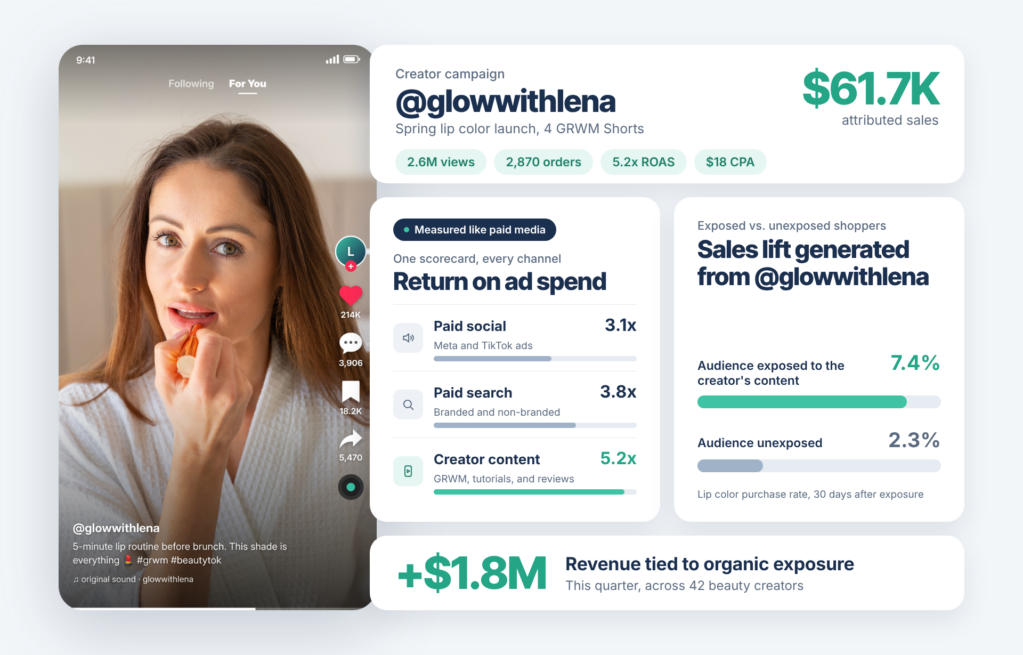
| Sales lift | Whether people exposed to creator content bought more than people who weren’t | Exposure to creator content, matched to purchase data in-store and online | Results outside the markets the data covers | StatSocial |
Most platforms cover the top of this table. Fewer connect creator exposure to real purchases, which is what leadership usually wants to see.
The 6 platforms, reviewed
1. StatSocial: best for proving sales impact among organically exposed audiences
StatSocial measures influencer campaigns by finding the verified people who were organically exposed to the creator’s campaign. Its patented Identity Graph, PeopleGraph, matches social profiles across 7 social networks to 219M real U.S. adults. That lets StatSocial identify who was organically exposed to a creator’s content, then match that group to first- or third-party purchase data. Teams see sales lift both in-store and online, without relying on promo codes or tracked links.
The same data helps before a campaign, too. Teams can check whether a creator’s followers match their target buyers, and StatSocial Digital Twins let them test messaging and creative concepts with that audience before launch, so they know what will resonate before they spend. StatSocial’s influencer measurement solution has been recognized by MarTech Breakthrough 3x in the past 5 years, and won ADWEEK’s 2025 Tech Stack Award for Marketing Measurement.
- Best for: Brands and agencies that need to prove a creator program drove sales, not just engagement, and want to pick creators based on who their target audience already follows.
- Limitation: Coverage is U.S.-focused. StatSocial is a measurement and audience layer, not a management tool, so teams typically pair it with a platform for contracts, content approvals, and payments.
- G2 rating: 4.3/5 from 127 reviews
2. CreatorIQ: best for enterprise benchmarking
CreatorIQ is an enterprise creator marketing platform used by more than 1,300 brands and agencies. Its Share Of metrics compare your brand’s exposure, engagement, and earned media value against competitors. They draw on a panel of 2M+ social accounts and 20K+ brands. Teams can also track Return on Creator Spend, which weighs creator pay and product costs against content performance.
- Best for: Global brands that run creator marketing as an always-on channel and report share of voice to leadership.
- Limitation: Earned media value estimates what attention would cost as paid media. It does not show who saw a post or whether they bought.
- G2 rating: 4.6/5 from 590 reviews
3. Traackr: best for benchmarking creator content
Traackr scores creator content with its Brand Vitality Score (VIT). VIT combines visibility (how many people the content reached), impact (how much engagement it earned), and trust (how focused the content is on your brand). Traackr publishes monthly leaderboards that rank brands by VIT, so teams can see how their creator program stacks up.
- Best for: Beauty, fashion, and consumer brands that want one score to compare their creator program against competitors.
- Limitation: VIT measures how content performs, not what the people who saw it went on to buy.
- G2 rating: 4.3/5 from 388 reviews
4. Captiv8: best for full-funnel tracking at holding-company scale
Captiv8 is an end-to-end influencer platform that Publicis Groupe bought in May 2025 and joined with Influential. Publicis says combining Captiv8 with Epsilon’s identity data and transaction data will give clients full-funnel measurement across platforms and media channels. Captiv8 operates in 120 countries and processes over 2.5B social posts a year.
- Best for: Large brands that want creator discovery, campaigns, social commerce, and measurement in one place, especially those already working with Publicis.
- Limitation: Its deepest measurement depends on identity data inside the Publicis ecosystem. Brands that work with other agencies should ask how much of it they can access.
- G2 rating: 4.7/5 from 505 reviews
5. Later: best for link-based sales tracking
Later pairs influencer software with a managed services team. In 2025, Later bought Mavely, a creator commerce platform, for $250M. That added 120K creators and the ability to connect creator posts to the sales they drive through tracked links.
- Best for: Mid-size and enterprise brands that want campaign support and a clear view of sales from each creator’s links.
- Limitation: Link-based tracking counts people who click and buy. It misses people who see a post and buy later, in-store or on another device.
- G2 rating: 4.5/5 from 469 reviews
6. Sprout Social Influencer Marketing: best for teams already on Sprout
Sprout Social Influencer Marketing is built on Tagger, a platform Sprout Social bought. It covers creator discovery, brand fit and safety checks, campaign management, and payments. Its reports track reach, engagement, conversions, and ROI, and compare your creator strategy to competitors and industry benchmarks.
- Best for: Social teams that already use Sprout Social and want influencer work in the same system.
- Limitation: Sales results depend on the conversion data you connect. Impact beyond tracked links and codes needs another source.
- G2 rating: 4.3/5 from 414 reviews
Note: G2 ratings are out of 5 and current as of October 2026. They come from each product’s G2 page in the Influencer Marketing Platforms category. Captiv8 is listed on G2 as Influential powered by Captiv8.
A comparison on how each tool measures results
Every platform on this list reports on influencer campaigns, but each one ties creators to a different kind of outcome. That decides what you can tell leadership.
| Platform | Main measure | Connected to | What it can show |
|---|---|---|---|
| StatSocial | Sales lift | Verified people organically exposed to creator content, matched to first- or third-party sales data | Whether people who saw the content bought more, in store and online, than people who didn’t |
| CreatorIQ | Earned media value, Share Of metrics, Return on Creator Spend | A panel of creator accounts and brands, plus your campaign costs and conversion data | Your share of creator attention and value compared with competitors |
| Traackr | Brand Vitality Score (VIT | Creator content that mentions your brand | How visible, engaging, and on-brand your creator content is compared with competitors |
| Captiv8 | Full-funnel campaign measurement | Epsilon identity data and transaction data within Publicis Groupe | Business impact across platforms and media channels, as described by Publicis |
| Later | Sales by creator post | Mavely tracked links | Clicks, purchases, and commissions from each creator’s links |
Sprout Social Influencer Marketing |
Reach, engagement, conversions, ROI | Campaign data and competitive benchmarks | How your campaigns perform and how your strategy compares with competitors |
The main difference is what sits behind the number. StatSocial ties exposure to real purchase behavior. CreatorIQ and Traackr score attention. Later tracks link-driven sales. Captiv8 and Sprout Social report on the campaigns that run on their platforms.
How to choose an influencer measurement tool
Start with the question leadership asks most about your creator program. Then pick the platform whose data is built to answer it.
| If your question is… | Start with |
|---|---|
| Did our influencer campaign actually drive sales, including in-store? | StatSocial |
| How does our share of creator attention compare to competitors? | CreatorIQ or Traackr |
| Which creator’s links drove the most sales? | Later |
| Can we run discovery, campaigns, payments, and reporting in one place? | Captiv8, CreatorIQ, or Sprout Social Influencer Marketing |
| How will a creator’s audience react to our message before we launch? | StatSocial Digital Twins |
Frequently asked questions
What is the best influencer measurement tool for 2027?
The best platform depends on what you need to prove. StatSocial leads for proving sales lift among verified people who saw creator content. CreatorIQ and Traackr lead for benchmarking creator attention against competitors. Later leads for link-based sales tracking.
What is the difference between earned media value and sales lift?
Earned media value (EMV) estimates what creator attention would have cost if you had bought it as paid media. It is based on impressions and engagement. Sales lift compares what people who saw a campaign bought with what similar people who didn’t see it bought. EMV shows attention. Sales lift shows business impact.
How do you measure influencer ROI without promo codes or affiliate links?
You need a way to know who saw the content. StatSocial identifies the verified people who were organically exposed to a creator’s posts, then matches them to first- or third-party sales data. That shows sales lift in-store and online, including from people who never clicked a link or used a code.
What is a good alternative to CreatorIQ for influencer measurement?
It depends on what you want to measure differently. For one score that benchmarks creator content against competitors, Traackr’s Brand Vitality Score is a common choice. For sales impact instead of earned media value, StatSocial ties exposure to verified purchase behavior across 219M U.S. adults. Many teams keep CreatorIQ for campaign management and add StatSocial for measurement.
Can I add an influencer measurement tool to a management platform I already use?
Yes. StatSocial works alongside any influencer management platform. Your current platform keeps handling discovery, contracts, and payments. StatSocial adds audience checks before a campaign and sales lift measurement after it.
How much do influencer measurement tools cost?
Most enterprise platforms, including StatSocial, CreatorIQ, Traackr, Captiv8, and Sprout Social Influencer Marketing, charge a yearly fee. The price depends on the number of users, creators, markets, and features you need. Later also offers managed services.
See what your influencer campaigns are driving
Engagement and clicks only tell part of the story. StatSocial shows you which verified people actually saw your creator content and what they bought next, in-store and online, with no promo codes or tracked links required. Check whether a creator’s audience matches your buyers before you sign. Then prove the sales to leadership once the campaign runs. StatSocial Digital Twins also let you test messaging with your target audience before you launch.