How to Calculate Influencer Marketing ROI Without Engagement Metrics & Promo Codes
To calculate influencer marketing ROI without relying on engagement metrics or promo codes, identify the audience organically exposed to a campaign, then match that audience against first- or third-party purchase data to compare their buying behavior to a similar, non-exposed control group. This mirrors how paid media has measured ROI for years, mapping who saw something to what they bought, something engagement metrics and promo codes alone can’t reliably do.
Influencer marketing has become a cornerstone for many brands, with 69% of consumers saying they trust influencer recommendations. Yet marketers who’ve measured paid media programs for years are often left in the dark when it comes to quantifying influencer campaign impact. In fact, 53% of marketers listed determining ROI as their top challenge. Here’s our take on why:
- The path to purchase isn’t always linear. A creator can include an affiliate link or promo code, but that doesn’t mean their follower buys immediately after seeing the content.
- Promo codes get widely shared. You can’t pinpoint whether a sale came from the influencer’s campaign or from a promo code aggregator site or browser extension.
- Engagement metrics can’t measure sales. Engagement and vanity metrics are good signals of content quality and interest, but they don’t reliably translate to sales, and they certainly don’t capture true sales impact.
Whether you’ve formally partnered with an influencer or one organically mentioned your brand, you want to know the effect on sales or other purchase behavior. We’re willing to bet you’ve sat through a post-campaign debrief where the “results” were really an educated guess, an uptick in sales, some social engagement and called it “a win,” while the paid media team reports exact purchase numbers. In this article, we show you how to prove sales impact, so you can report on the campaign results your executive team cares about.
In this article we highlight:
Why haven’t marketers been able to measure influencer marketing ROI?
How do you calculate influencer marketing ROI, step by step?
How did Nestlé measure a 25% sales lift from influencer marketing?
FAQ: Measuring influencer marketing ROI
Why does accurate influencer marketing ROI matter?
Why haven’t marketers been able to measure influencer marketing ROI?
With most paid media campaigns, you can identify which individuals interacted with your ad and made a resulting purchase. Influencer marketing hasn’t historically worked that way, not because it’s a different kind of channel, but because there hasn’t been a way to map the people exposed to an influencer’s campaign back to sales.
Audience intelligence technology like StatSocial’s platform closes that gap: it identifies the individuals exposed to your influencer or organic social campaign and connects that exposure to a resulting purchase.
How do you calculate influencer marketing ROI, step by step?
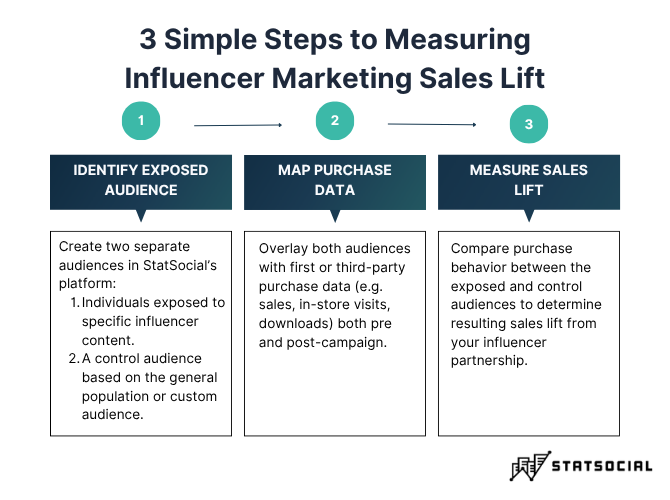
Measuring influencer marketing ROI might seem like an impossible task, but it’s rather Measuring influencer marketing ROI sounds complex, but with the right platform, data, and steps, it’s straightforward. Influencer campaign measurement needs two essential ingredients:
- Organically exposed social audience data
- First- or third-party purchase data
With access to social audience data from a platform like StatSocial’s, you can identify the individuals organically exposed to your influencer or social campaign, then map those audiences to purchase data, alongside a matched control group who was not exposed to compare purchase behavior.
How did Nestlé measure a 25% sales lift from influencer marketing?
For a company like Nestlé, influencer marketing is essential, but after significant investment in the channel, they needed more precise results to optimize future spend. To move beyond traditional engagement metrics, they partnered with StatSocial to link exposed audiences to purchase data for the first time.
Nestlé’s influencer partners and campaign strategy
Nestlé launched an influencer and social campaign to boost sales of their frozen food brands, DiGiorno and Hot Pockets, partnering with creators including:
- NRG Sports
- IamDices
- Vincent Marcus
- Ross Smith
They ran parallel campaigns across their own owned social accounts for both brands.
The steps Nestlé took to measure sales lift
Step 1: In the StatSocial platform, Nestlé created two audiences:
- Individuals organically exposed to influencer and owned content across Instagram, X, TikTok, and YouTube.
- An unexposed social audience to serve as the control group.
Step 2: Nestlé’s analytics team, working with their purchase data provider, matched the exposed and unexposed audience to point-of-sale data over 150 days
Step 3: By comparing purchase behavior across exposed and unexposed groups before, during, and after the campaign, Nestlé measured the associated sales impact.
Nestlé’s findings
Compared to the non-exposed control group, audiences following Nestlé’s owned DiGiorno and Hot Pockets social accounts spent 9.3% ($0.38) and 25.3% ($0.35) more, respectively. Influencer partner audiences showed a marginal effect with influencer, Ross Smith driving just a 0.8% lift.
| Dollar Change % Lift | Incremental Dollar <br>Spent per Exposed Shopper | |
|---|---|---|
| DiGiorno Organic Following | 9.3% | $0.38 |
| Hot Pocket Organic Following | 25.3% | $0.35 |
| NRG Social Following | -0.6% | $0.00 |
| Ross Smith Following | 0.8% | $0.01 |
| Combined Influencer Following | 0.2% | $0.00 |
| New Buyer <br>Penetration | Existing Buyer<br>Trips/Buyer | Existing Buyer<br>Dollar/Trip | |
|---|---|---|---|
| DiGiorno Organic Following | 8.2% | -2.5% | 3.7% |
| Hot Pocket Organic Following | 23.7% | -4.4% | 5.9% |
| NRG Social Following | -0.4% | 7.3% | -7.4% |
| Ross Smith Following | 0.8% | -0.2% | 0.0% |
| Combined Influencer Following | 3.1% | -3.6% | 0.7% |
These findings led to two major insights:
- Targeting adjustments: The influencers reached younger audiences (the ‘consumers’) rather than household purchasers (parents or caregivers). Nestlé determined future influencers and social campaigns should target household shoppers more directly.
- Value of owned channels: Nestlé realized their own social channels had a significant impact on sales, prompting them to amplify their owned accounts in future campaigns.campaigns.
Had they not identified those organically exposed with StatSocial, Nestlé may have misattributed social engagement to sales, leading to less informed decisions on future partnerships and potentially losing budget dedicated to influencer marketing.
This milestone allowed Nestlé to attribute actual sales to their influencer programs, aligning with measurement standards long established in other areas of marketing.
As Nestlé’s former Head of CX Marketing Analytics, Daniel Davidson, put it:
“Regardless of the results, the biggest takeaway from partnering with StatSocial was the ability to finally measure the direct sales impact resulting from our campaign–a capability that other marketing channels have been able to do for years.”
FAQ: Measuring influencer marketing ROI
How do you calculate influencer marketing ROI without promo codes?
Identify the audience organically exposed to a creator’s content, match that audience to purchase data from a first- or third-party source, and compare their buying behavior to a similar non-exposed control group.
Why are engagement metrics not enough to measure influencer marketing success?
Engagement (likes, comments, shares) signals content quality and interest, but don’t reliably indicate whether someone made a purchase. It also can’t be compared apples-to-apples with the purchase-based metrics used to evaluate other marketing channels.
What data do you need to measure influencer campaign ROI?
Two things: organically exposed social audience data and first- or third-party purchase data to measure purchase behavior KPIs before, during, and after the campaign.
What did Nestlé learn from measuring influencer ROI directly?
Nestlé found their owned social channels drove more sales lift than several influencer partnerships, and that their influencer partners were reaching younger consumers rather than the household shoppers who make the purchase. These insights reshaped their targeting and channel investment going forward.
Why does accurate influencer marketing ROI matter?
Measuring influencer marketing ROI accurately helps brands connect exposure to actual sales and other performance metrics, rather than relying on proxies, and ultimately proves whether influencer marketing is a valuable channel. By partnering with StatSocial, companies can finally assess how paid and organic influencer campaigns contribute to ROI, in-store traffic, and brand perception. That holistic view enables data-driven decisions and better-optimized influencer strategies.
StatSocial’s influencer measurement solution is used by global agencies, Fortune 500 brands and has been awarded ADWEEK’s Tech Stack Award and is a three time MarTech BreakThrough award recipient.
Learn more about StatSocial’s influencer marketing solution or schedule an introductory call with a member of our team to get started.