Know the political preferences of your customers, and the voices that actually reach them
This blog was originally published on June 5th, 2024 and updated on September 4th 2026 to include our StatSocial Political Influencer Index 2026
“Never discuss politics or religion in polite company.” For years, brands lived by that rule, until a decade of cause marketing convinced the industry of the opposite: that boldly supporting a cause would invariably benefit a brand. Target’s last three years show that neither rule holds. Conservative boycotts over Pride merchandise pushed it to pull products in 2023. Then, in January 2025, it rolled back its DEI programs and the backlash came from the other direction: a boycott that ran more than a year, foot traffic down almost every month, a 30% slide in the stock, and a CEO out the door.
The reverse happens too. American Eagle’s 2025 Sydney Sweeney campaign was accused of eugenics undertones, then became a full political fight a week later when Sweeney’s Republican voter registration surfaced and the White House weighed in on her behalf. American Eagle still posted record new-customer acquisition that quarter. Loud does not mean lost, and quiet does not mean safe. There isn’t a universal right answer. There’s only the question of whether you actually know where your audience stands.
With the 2026 midterms approaching, that question matters more than usual, for political organizations and consumer brands alike. Answering it takes political audience intelligence: a measured read on where an audience actually sits, not an assumption drawn from demographics or gut feel. StatSocial approaches it from two directions: Insights Reports, which tell you where your audience sits on the political spectrum, and the newly released Political Influencer Index, which tells you which voices actually reach, and move, the audiences you care about. Together, they turn “know your audience’s politics” from a guess into a measurement.
Fast forward 5 years to a post-pandemic and deeply divisive political culture, that sentiment may have waned. And if the Bud Light Boycott taught us anything, it’s that taking a political stand that differs from your audience can cost you millions.
But what if brands could anticipate how their next campaign, influencer or political based messaging will go over with their audience? In the following section we’ll dive into how StatSocial’s social audience insight platform is helping brands understand their audience’s political viewpoints.
Know the political preferences of your audience
Every StatSocial Insights Report includes a dedicated Politics section, built to give brands, agencies and political organizations a clear read on the audience behind any handle, list or customer file. It’s political audience intelligence at the level that matters most to you: your own customers, followers and prospects.
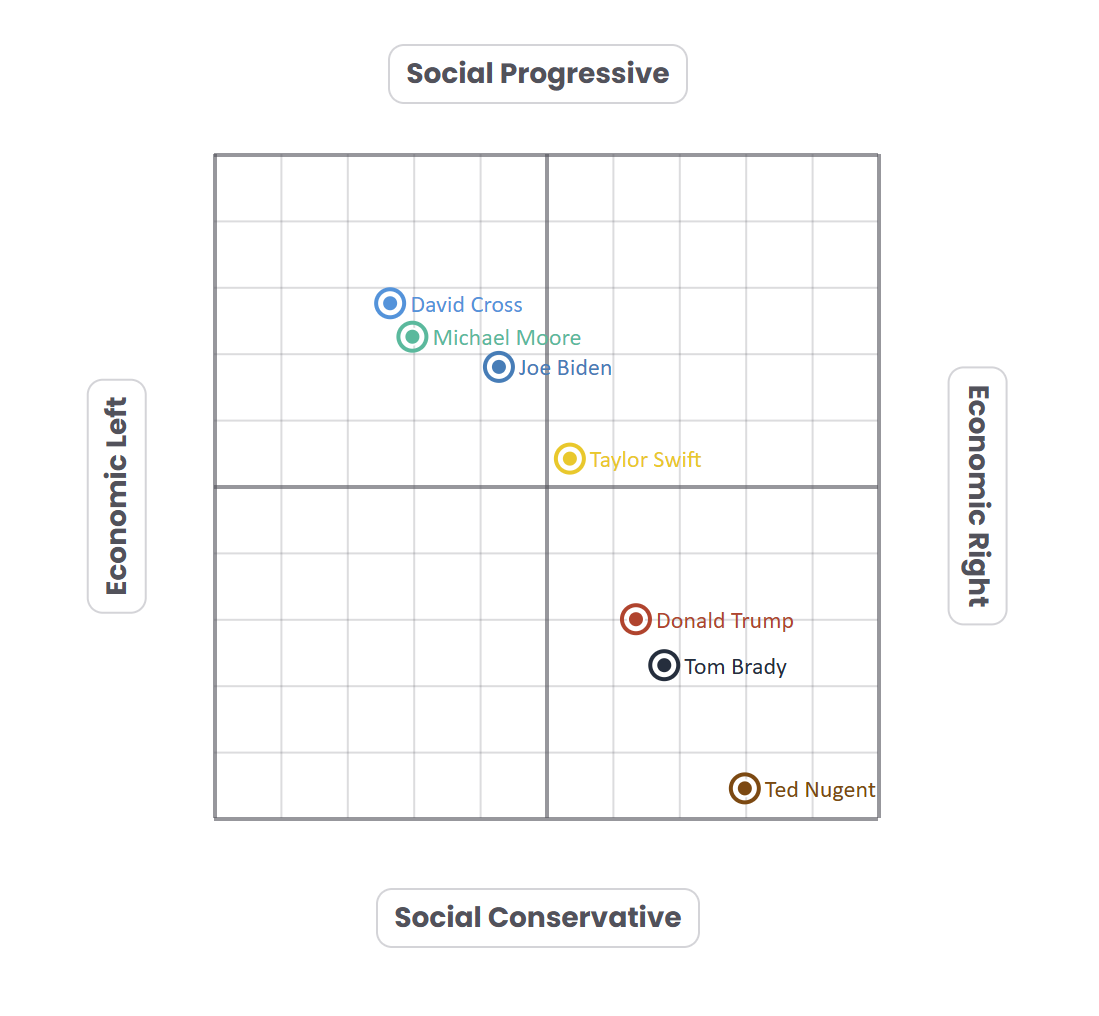
Political Compass: See exactly where an audience falls on the political spectrum, how far left or right it leans relative to a baseline. Understanding that lean is the first signal for which social and economic issues an audience is likely to care about.
Relevant Political Topics: Beyond left and right, see which specific issues an audience is most engaged with, from tax policy to climate to gun laws, so campaigns and social-impact partnerships align with what actually matters to the people you’re trying to reach.
Political Influencers: See which political figures and commentators an audience already follows and engages with. The politicians and pundits someone chooses to follow are a strong proxy for their underlying values and beliefs, often a clearer signal than demographics alone.
Any brand or organization weighing whether, and how, to take a public stand can use these three views to replace intuition with evidence.
Beyond your audience: know the voices that reach them
Knowing your audience’s political leaning answers half the question. The other half is knowing who actually commands their attention, because in 2026, that isn’t necessarily who you’d expect.
StatSocial’s Political Influencer Index 2026 measured the audiences behind more than 500 political voices, pundits, journalists, podcasters, comedians and elected officials, across 39 rankings and every U.S. state, using zero surveys, panels or modeled responses. Every figure comes from cross-platform public social data resolved to real identities, political audience intelligence built from what people actually do rather than what they tell a pollster. A few of the findings:
- Attention has moved outside of politics. Not one of the ten largest audiences in political conversation belongs to a working news journalist. The list is led by podcasters, comedians and commentators, the largest journalist audience, Anderson Cooper’s, is roughly an eighth the size of the largest audience overall.
- Reach and relevance are different things. More than half of the 225 voices who place in a top ten anywhere in the Index appear on exactly one list. A single follower count can’t tell you whether a voice actually moves the audience you care about, or which one.
- Echo chambers and bipartisan reach sit in surprising places. The ten most politically concentrated audiences in the Index all belong to the populist right. But the ten most bipartisan audiences don’t belong to the center-left, they belong to heterodox and Never Trump right-leaning voices instead.
- Geography changes the leaderboard entirely. The voices with the largest overall audiences are largely absent from the rankings of who reaches the 2024 battleground states, who dominates local news consumption, or who has the strongest presence in Washington, D.C.
- Every state has its own most-concentrated voices, a five-person leaderboard per state, benchmarked against the Index average, covering all 50 states plus the seven 2024 battlegrounds.
The Index also breaks down audiences by demographics (age, gender, race and household income), by profession and industry, from law enforcement to legal professionals to construction and trades, and by engagement with specific policy issues like healthcare, inflation, foreign policy and criminal justice reform.
As StatSocial President Michael Hussey put it, “This year’s Index shows that who matters can shift dramatically depending on which audience, or which political community, you’re trying to reach, and that’s especially true heading into the midterms.”
Where the two capabilities meet
Used together, Insights Reports and the Political Influencer Index deliver complete political audience intelligence, your audience and the voices that shape it:
- Start with your own audience. Run an Insights Report on your customer base, prospect list or social following to see its political compass, the issues it cares about most, and the political figures it already follows.
- Find the voices that actually reach that audience. Use the Political Influencer Index to see which of the 500+ measured voices best match that lean, that issue set, or that geography, or to check whether a creator you’re considering partnering with is a bipartisan-reaching voice or a deeply concentrated echo chamber.
- Test the message before launch. Digital Twins turn that same audience into a research panel you can question directly, so a focus group on a politically sensitive campaign runs against your actual customer composition instead of a recruited sample that may not match it. Ask how the left-leaning share of your audience reads a piece of creative, then ask the right-leaning share the same question.
- Validate before you commit. Before sponsoring a political commentator, aligning with a cause, or greenlighting messaging with any cultural edge, check both sides: does this match our audience’s actual composition, and does the voice we’re considering actually reach the audience we think it does?
The Index runs on the same underlying platform available to every StatSocial customer, so the analysis isn’t limited to the 500 voices already published. Bring us a talent roster, a competitor’s following, a customer list, or any other audience you care about, and we’ll run the same measurement against it: audience reach, political composition, geography, demographics, profession, and issue engagement, all built from real people rather than survey samples.
Who should be using this
The teams getting the most out of political audience intelligence:
- Political organizations, campaigns and PACs
- Public affairs and lobbying firms
- Agencies with political clients, or clients considering political or cultural positioning
- Brands vetting influencer or spokesperson partnerships with any political exposure
- Any brand or agency that wants a real read on its audience’s cultural and political nuance before its next campaign
Real brands that have taken a stand
Most companies still avoid political topics as a rule. But a handful have built real loyalty through consistent, well-understood positioning:
- Patagonia centers its brand on environmental and social responsibility, and is vocal and consistent about both its mission and its progress.
- TOMS built its giving model, a third of profits directed toward causes like mental health and sustainability, directly into its stated mission.
- Ben & Jerry’s is arguably the boldest of the three, describing its own mission as a “progressive, nonpartisan social mission” aimed at addressing injustice through its day-to-day business.
What these brands share isn’t the specific position, it’s that the position matches an audience they understand deeply. That match is the part that can now be measured rather than assumed.
Want political audience intelligence on your own customers, and the voices that actually reach them? Schedule a free demo or explore the full 2026 Political Influencer Index.